
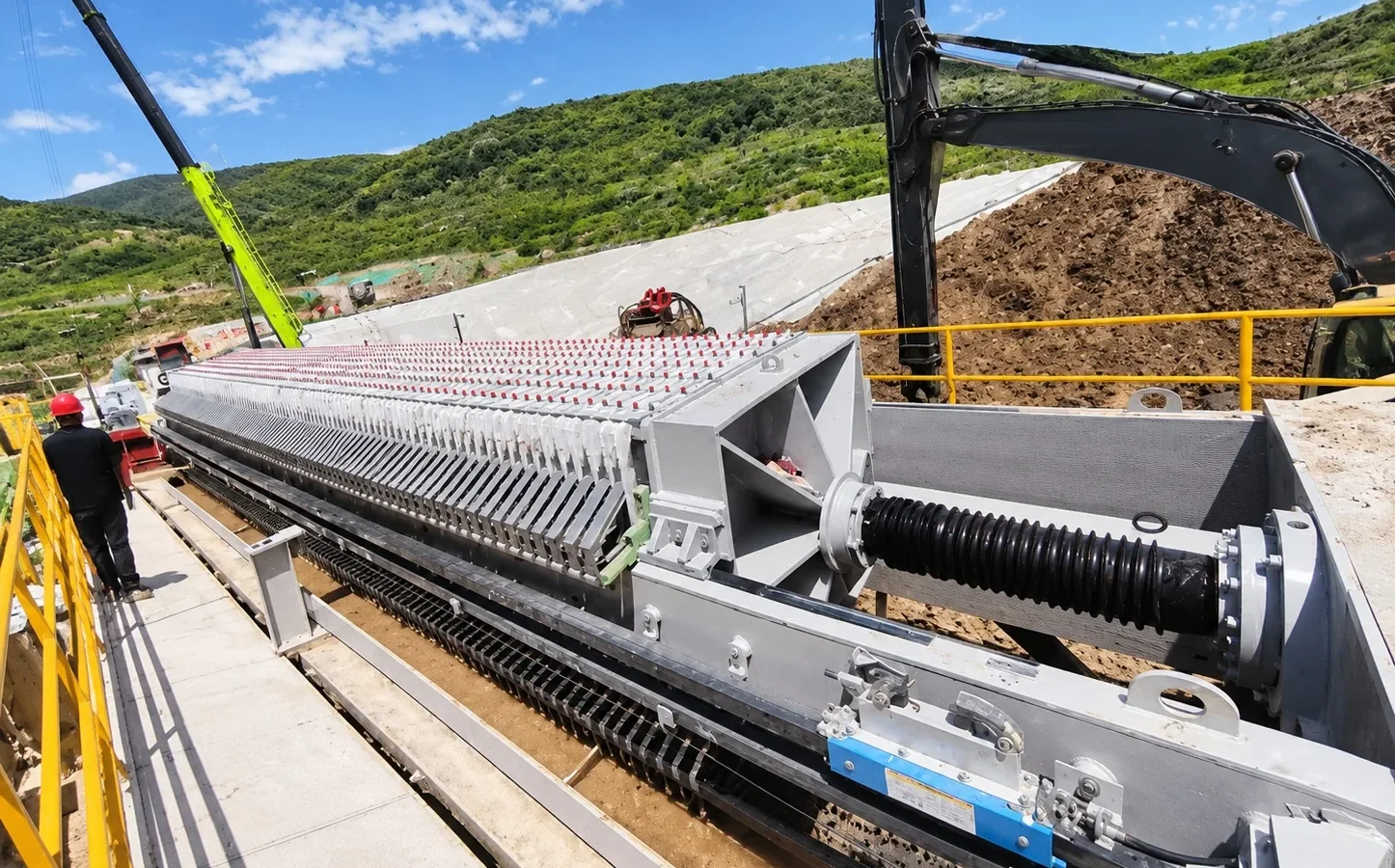
A filter press is a batch solid-liquid separation device. It receives a slurry, retains solids as a cake and discharges filtrate, but it is not a clarifier, a thickener or a continuous conveyor. Understanding where it sits in the treatment circuit prevents it from being asked to do work that belongs upstream.
Where the press fits in the circuit
In a typical dewatering circuit, the slurry is first equalised or thickened, then conditioned if necessary and finally fed to the press. The press removes water from the solids; the thickener reduces the volume that the press must handle; the feed pump controls how the chamber fills. Each item has a different job.
If the feed is too dilute, the press spends most of its cycle handling water. If the feed contains material that blinds the cloth or forms a soft cake, a larger press may not solve the problem. The circuit should be evaluated as a system rather than as a list of equipment capacities.
The batch sequence
- The plates are closed and sealed.
- Feed slurry enters the chambers.
- Filtrate passes through the cloth while solids accumulate as cake.
- Washing or membrane squeezing may follow, depending on the process.
- Air may be used to displace liquid from the cake and pipework.
- The press opens and the cake is discharged.
- The cloth and chamber are prepared for the next cycle.
Capacity depends on the complete sequence. A press that filters quickly but discharges slowly may have a lower net throughput than a slower-filtering press with reliable cake release.
What the press does well
A filter press can produce a relatively dry cake, deliver a clear filtrate when the cloth and cake are correctly matched, and recover water for reuse. It can be configured for washing, squeezing, air blowing and automatic plate movement. It is particularly useful where the product needs a consistent cake and the process can operate in batches.
These capabilities depend on the slurry. A press that performs well on a granular mineral slurry may behave differently on a fine clay, an oily sludge or a chemically reactive precipitate.
What it does not do
A filter press does not provide a large buffer volume. It does not continuously remove a small stream of solids while the rest of the plant runs unaffected. It does not replace clarification or thickening, and it does not fix an unstable feed by itself.
It also does not guarantee a specific cake moisture or filtrate quality without representative testing. Those results depend on the solids, pressure, cloth, conditioning and complete cycle. A catalogue figure cannot substitute for a trial on the actual material.
Main configurations
Chamber filter presses use recessed plates and rely mainly on feed pressure. They are often used for general sludge and mineral dewatering where the target moisture can be reached without a squeeze phase.
Membrane filter presses add a squeeze stage after filtration. The membrane can reduce cake moisture when the cake is compressible, but the extra phase adds equipment, utilities and maintenance. The benefit should be measured with the actual slurry.
Plate-and-frame designs use separate frames and can accommodate different filter media and cake thicknesses. High-pressure designs use heavier construction for difficult materials, but higher pressure is not automatically better for a compressible cake.
What to define before selection
Start with feed solids and flow, target dry-solids throughput, cake moisture basis, filtrate quality, operating hours and the handling route for the cake. Add the available footprint, headroom, utilities and maintenance resources. These inputs determine whether the press should be chamber, membrane, plate-and-frame or another configuration.
Then test a representative sample. The test should show cake formation, filtrate clarity, pressure response, cake release and the effect of any conditioning chemical. A sizing exercise without that evidence is only a starting point.
Integrate the press with the rest of the plant
The feed pump should match the filtration curve, the thickener should deliver a manageable solids concentration and the cake-handling system should accept the expected cake size and consistency. The filtrate route should accommodate the maximum flow and any wash water. A well-sized press in a poorly integrated circuit will still create operating problems.
The press is therefore best understood as one unit in a dewatering system. Its value comes from producing a handleable cake and a reusable filtrate at a predictable rate, not from being the largest or most complex machine on the site.
Selection and sizing should be confirmed with representative slurry testing and a review of the complete treatment circuit.