
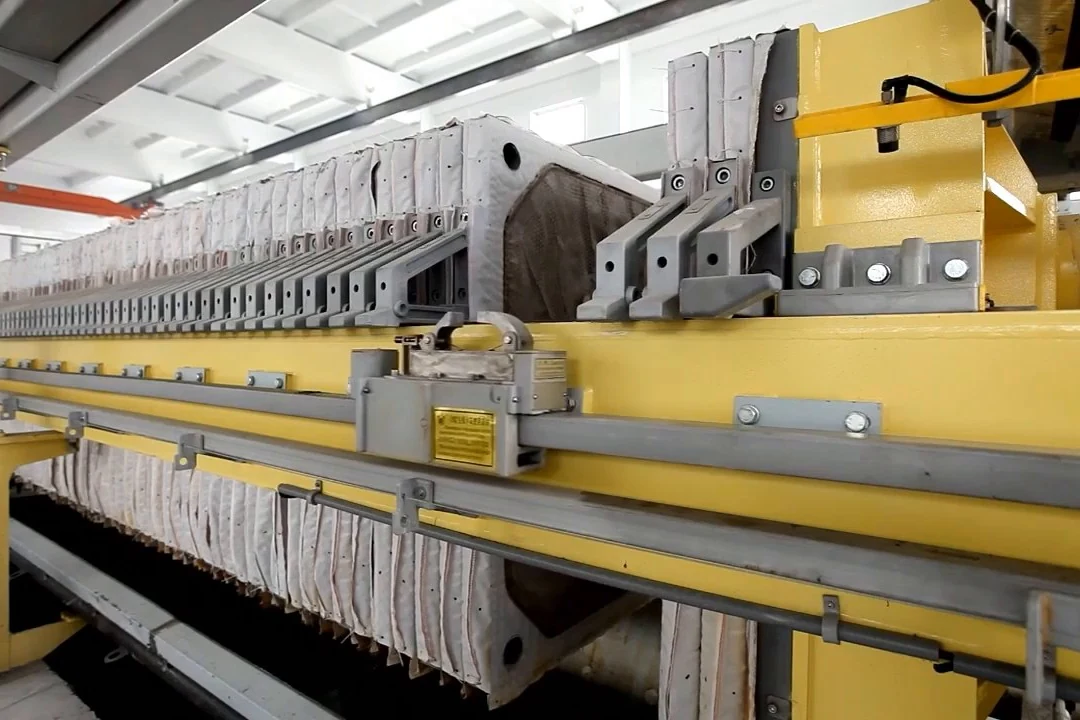
Filter press capacity is often quoted as a filtration area, a chamber volume or a maximum feed flow. None of those numbers alone describes how much dry solids the plant can process in an operating day. A defensible capacity calculation starts with the batch mass balance and the complete cycle.
Define what the capacity figure represents
Capacity can mean wet feed volume, wet cake mass, dry solids mass or filtrate volume. For plant design, dry solids per operating hour is usually the most useful measure because it is not affected by changes in feed concentration. The calculation should use the same moisture basis as the cake specification and the same operating hours as the plant schedule.
Start with the wet cake
If a cycle produces a wet cake mass and the cake moisture is known on a wet basis, the dry solids mass is:
Dry solids per cycle = wet cake mass × (1 − moisture fraction)
For example, 1,200 kg of wet cake at 65% moisture contains 420 kg of dry solids. The same calculation applies to a smaller sample, provided the sample is representative and the moisture basis is stated.
Convert the cycle into an hourly rate
The next step is to divide the operating period by the complete cycle time, not only the filtration time:
Cycles per hour = 60 ÷ complete cycle time in minutes
Dry solids per hour = dry solids per cycle × cycles per hour × availability
If the complete cycle takes 40 minutes, the press can complete 1.5 cycles per hour. With 420 kg of dry solids per cycle, the gross rate is 630 kg/h. At 85% availability for cleaning, maintenance and interruptions, the planning figure is about 536 kg/h.
Chamber volume is not cake volume
The chamber volume sets the upper limit for the wet cake that can be retained, but the useful volume is lower than the theoretical figure. Cloth thickness, gaskets, incomplete filling and cake shrinkage reduce the actual amount. The cake may also not fill every chamber uniformly.
Use the expected cake thickness and a realistic fill factor rather than assuming that every chamber is full. A press with a large theoretical chamber volume may not reach that volume when the feed solids are low or the filtration cycle ends early.
Count the whole cycle
The cycle includes filling, filtration, optional washing, optional membrane squeezing, air blow, opening, discharge and cloth inspection. A short filtration phase does not guarantee high capacity if the cake must be washed for a long time or discharged manually.
Record each phase separately in a trial. If the press is opened before the cake is fully formed, the next cycle may start sooner but the cake mass and dryness will fall. If the press is held closed too long, water may be removed slowly with little additional benefit. The endpoint should be defined by flow, pressure or product quality, not by a habit.
Filtration area and throughput answer different questions
Filtration area describes the surface available for filtrate flow. Throughput describes the dry solids processed per hour after the cake mass and cycle time are known. Two presses with the same area can have different chamber volumes, cake thicknesses, cloths and discharge times.
This is why a comparison based only on area can be misleading. The area is a useful design input, but the operating capacity must be calculated from the actual cycle and the material’s filtration behaviour.
Collect the data needed for a reliable estimate
- feed solids concentration and feed volume per cycle;
- wet cake mass and moisture, with the basis stated;
- cake thickness and the number of chambers actually filled;
- time for filling, filtration, washing, squeezing, air blow and discharge;
- filtrate volume and clarity at the end of filtration;
- planned cleaning, maintenance and cloth replacement time;
- the range of feed conditions expected in normal operation.
A capacity calculated from one ideal cycle is not a plant capacity. Use several cycles, including a representative difficult condition, and state whether the result is gross or net of availability.
Use the calculation as a check on the specification
When a supplier quotes a throughput, reconstruct the implied cake mass, moisture and cycle time. If the numbers require an impossible chamber fill, an unrealistically short discharge or a moisture value that is not comparable, the quote needs clarification.
The final selection should combine this mass balance with representative filtration testing, a review of the complete cycle and a realistic maintenance plan. That approach produces a capacity figure the plant can actually operate, not only a number that looks favorable in a proposal.
Capacity calculations should be checked against measured cycle data and the stated moisture basis. A single theoretical calculation is not a substitute for representative testing.